
ICU Trials by ClinCalc
ClinCalc LLCMedical
4.616.00 Reviews
- Version
- 2026.07
- Installs
- 10.00K
- Age Rating
- Everyone
Screenshots
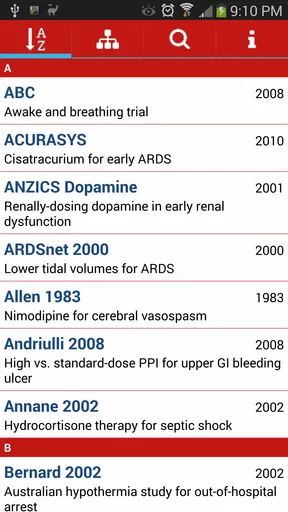
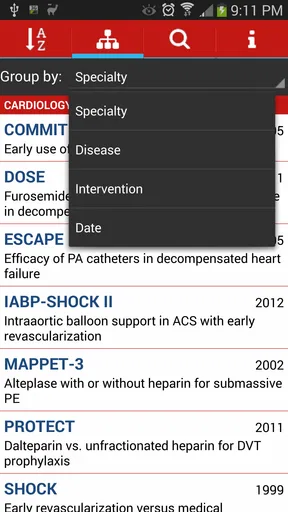
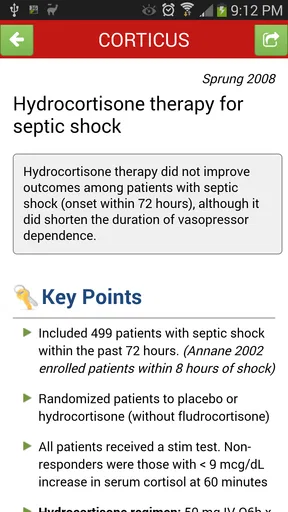
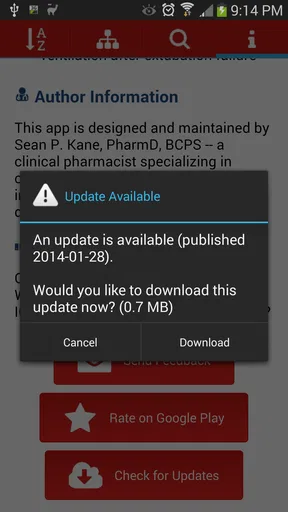
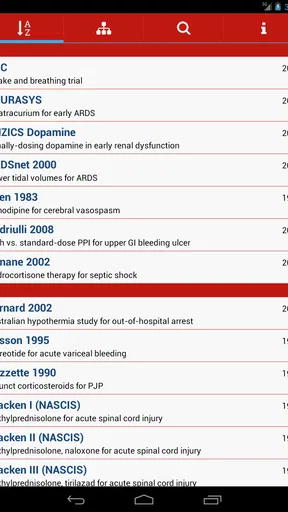
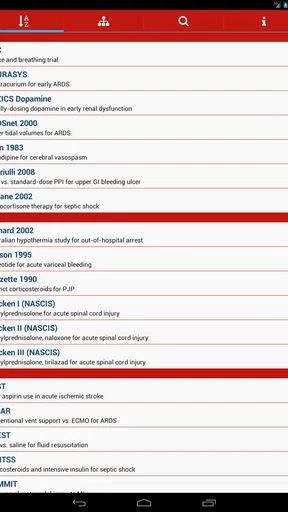
Our Review of ICU Trials by ClinCalc
 Analysis by Appyee
When I review a medical reference app, I am less interested in how impressive the description sounds than in whether it helps me think clearly when time is limited. ICU Trials takes a focused approach: it brings summaries of landmark critical care trials into a mobile format for quick consultation. That makes it very different from a general medical encyclopedia or a broad drug reference. Its value depends on whether you want a compact way to revisit evidence, not whether you need a complete clinical information system.
ClinCalc LLC developed this app for the kind of reader who already understands medical language and wants a practical reminder of important intensive-care research. I found that focus useful. Instead of trying to cover every part of medicine, the app centers its identity on critical care trials. It is listed as a Medical app, rated for Everyone, and costs $4.99. That price positions it as a small professional reference purchase rather than a casual free download.
The app has been available since June 9, 2012, and its current version is 2026.07. It requires Android 8.0 or later, so it remains accessible on many older devices while still fitting comfortably on newer phones. Its average rating is 4.6 from around 227 ratings, with over 10 thousand installs. Those figures suggest a specialized audience rather than a mass-market medical tool, which matches my experience of its narrow purpose.
How the app feels when connectivity becomes part of the workflow
I’d treat connectivity as a practical part of using a medical reference, not just a convenience: a stable connection can make it easier to find the right trial before a discussion, while a rushed lookup during a weak-signal moment can interrupt the workflow. My habit would be to identify the evidence I need ahead of time and keep a trusted alternative ready, so the next step is considering how that handoff works when a quick summary needs deeper verification.
Network-dependent moments change the way I use a reference tool
The first thing I would consider before relying on any medical app is how it behaves when my connection is inconsistent. ICU work can happen in places where mobile reception is weak, hospital Wi-Fi requires a sign-in, or a device is being used while moving between wards. A reference app is most useful when it can be reached without creating another delay, so connectivity is not a minor technical detail here; it affects the practical value of the whole experience.
With ICU Trials, I would treat the network situation as part of my preparation rather than assume that every moment will be equally convenient. Before using it during a busy shift, I would open the material while connected, become familiar with the sections I expect to consult, and avoid making the first exploration happen during an urgent discussion. That habit is useful for any mobile reference, but it matters especially for an app built around trial summaries, where the point is to retrieve a specific piece of evidence rather than browse aimlessly.
I also would not confuse quick access to a summary with a complete answer to a clinical question. A trial overview can help me recall the design, intervention, comparison, or main conclusion I am looking for, but it should not replace local protocols, current guidelines, patient-specific assessment, or direct review of the original publication when the decision is complex. The app works best as a memory aid and evidence-navigation tool.
That distinction is one of its strengths. Because the subject is limited to landmark critical care trials, I can approach it with a question in mind: Which study changed how this intervention is understood? What was the comparison? Why does this trial still come up in teaching or discussion? A broad search engine may return more pages, but more results do not always mean faster understanding.
Mobile use is strongest during short gaps rather than long study sessions
I see the most convincing use case in the small spaces between larger tasks. Imagine a resident preparing for a teaching conversation about a familiar ICU intervention. There may be only a few minutes before rounds, and opening a general search engine could produce guidelines, advertisements, textbook pages, and unrelated studies. A focused trial reference gives that person a better starting point for recalling the evidence behind the discussion.
The same applies to a clinician reviewing a topic after a shift. A phone is less intimidating than a laptop, and a concise summary can make it easier to revisit one landmark study without committing to a full literature search. I would use the app to refresh my mental map, then move to a more detailed source if the question involved a patient, a disputed interpretation, or a decision with serious consequences.
Students may also find the mobile format helpful when preparing for exams or teaching sessions. The important trade-off is that convenience can encourage shallow reading. It is easy to remember a trial’s headline result while forgetting its population, exclusions, endpoints, or limitations. My practical tip would be to turn each summary into a question: Who was studied, what exactly was compared, and what would make the result less applicable to the patient or setting in front of me?
That workflow makes the app more valuable than simply scrolling through summaries. I would keep a short list of topics I repeatedly encounter, use the app to refresh one trial at a time, and then verify any detail that could influence care. The phone becomes a prompt for disciplined review rather than a substitute for clinical reasoning.
What happens when the connection fails?
A connectivity problem is most frustrating when it appears at the exact moment a reference is needed. I would therefore avoid treating ICU Trials as the only source in a time-sensitive situation. If the app takes longer to open, a page does not load as expected, or the device loses access while I am moving through the hospital, the correct response is not to improvise from memory. I would switch to an approved local reference, institutional protocol, or another trusted resource.
This is also where the app’s focused scope helps and limits the experience at the same time. A narrow trial collection is easier to approach than an enormous database, but it cannot answer every question that arises in intensive care. If I need dosing information, a current contraindication, a bedside calculator, a guideline update, or a patient-specific recommendation, I would choose a tool designed for that task instead.
For recovery after a failed connection, my preferred routine would be simple. I would return to the app when the network is stable, locate the trial again, and check the surrounding context rather than relying on a single remembered sentence. If I had already written down a conclusion during the interruption, I would treat it as provisional until I could review the source properly.
This may sound cautious, but it is exactly the right attitude for a medical reference. The app’s role is to support informed reading, not to create false confidence. A smooth mobile experience is convenient; it does not turn a summary into a universal rule.
Using it thoughtfully when data access matters
For anyone managing a limited mobile plan, the sensible approach is to use the app deliberately. I would connect through a trusted Wi-Fi network before exploring unfamiliar sections, avoid repeatedly reopening the same material during poor reception, and keep my consultation focused on the clinical question I brought with me. These are ordinary habits, but they reduce frustration and make the app feel more dependable in everyday use.
I would also be careful about where I use any medical reference on a phone. A public setting can create privacy concerns if patient details are visible beside the app, even though the trial content itself is not patient data. The safest workflow is to keep identifiable information out of searches and notes, use the app for general evidence review, and follow the rules of the workplace or institution.
Another useful habit is separating reading from decision-making. I might consult a trial summary while preparing for a discussion, but I would not use a quick glance as permission to apply an intervention automatically. Instead, I would compare the study context with the actual patient population, current practice, and advice from the responsible clinical team. This is where the app earns its place: it can improve the quality of a conversation without pretending to replace one.
People often ask whether a focused app like this is better than simply searching the web. For a single obscure question, a web search may be faster. For repeated review of landmark critical care trials, the focused approach is more useful because it reduces the noise and keeps attention on evidence that has shaped the field. The trade-off is breadth: search engines and large databases can lead to newer papers, broader context, and more detailed source material.
Who should use it, and who should skip it?
I would recommend ICU Trials to medical students, residents, fellows, educators, and clinicians who regularly discuss intensive-care evidence and want a compact reference for landmark studies. It is particularly suitable for someone who learns through repeated short reviews rather than one long study session. The modest one-time price is easier to justify if critical care trials are part of the reader’s regular education or work.
I would skip it if I wanted a general-purpose clinical assistant. Someone looking for medication dosing, laboratory interpretation, procedural instructions, diagnosis support, or a comprehensive literature database will probably be better served by specialized alternatives. The app’s narrow subject is not a flaw, but it does mean that its usefulness depends heavily on your role and interests.
I would also be cautious about recommending it as a stand-alone resource for a newcomer who has not yet learned how to read clinical trials. Summaries are easier to consume than full papers, but that convenience can hide important details. A beginner may benefit more from a structured evidence-based medicine course or textbook first, then use this app to reinforce the key studies afterward.
My practical verdict on the connected experience
Connectivity shapes ICU Trials less by changing its medical subject matter than by determining when the reference is convenient to reach. I would use it during preparation, teaching, revision, and non-urgent evidence checks, with a reliable connection whenever possible. I would not build an emergency workflow around assumptions about access, and I would always keep a trusted clinical alternative available.
What I like most is the clear purpose. ClinCalc LLC has not tried to make this a generic medical app; it is a compact doorway into landmark critical care trials. That focus can save time when I already know the topic I want to revisit. The main limitation is equally clear: a summary collection cannot provide the depth, currency, or patient-specific judgment of guidelines, original research, or institutional resources.
After using it as a reference rather than a decision-maker, I would recommend it to readers who want evidence reminders on a phone and understand the importance of checking context. The Everyone age rating makes it broadly available, but the subject matter is still aimed at serious learners and healthcare professionals. Its best role is a fast bridge between clinical memory and deeper reading.
At $4.99, I see it as a reasonable purchase for someone who will return to critical care trial summaries regularly, especially if a focused mobile library fits better than a large subscription service or an open-ended web search. It is less compelling for occasional users who only need one answer or for anyone expecting a complete bedside reference. My final recommendation is therefore conditional but positive: choose it when landmark ICU evidence is your recurring question, prepare for connectivity interruptions, and use every summary as a starting point for careful clinical thinking.
Verdict
Strengths of ICU Trials by ClinCalc
- Helps estimate ICU mortality risk with established clinical prediction models.
- Combines multiple scoring systems in one convenient mobile reference.
- Useful for bedside teaching, case discussions, and clinical research planning.
- Clear input fields make most calculators quick to complete.
- Can support consistent risk assessment across different patient cases.
Limitations of ICU Trials by ClinCalc
- Risk estimates are not a substitute for clinical judgment or individualized care.
- Some models require laboratory or physiological data that may not be immediately available.
- Older calculators may not reflect the latest evidence or local ICU practices.
- Results can be misleading when patient details fall outside a model’s intended population.
- Primarily useful to healthcare professionals, not general users or patients.
Similar Picks in This Category
View All
WebMD: Symptom Checker
WebMD, LLC4.1

Microphone Amplifier
DOSA Apps4.2

Anatomy Learning - 3D Anatomy
3D Medical OU4.5

Period Tracker and Calendar
SimpleInnovation4.9

GoodRx: Prescription Coupons
GoodRx4.8

CVS Health
CVS Pharmacy4.5
Frequently Asked Questions
What is ICU Trials by ClinCalc used for?
ICU Trials by ClinCalc is a medical reference app designed to help clinicians, students, and healthcare professionals review important randomized clinical trials related to critical care and intensive care medicine. It presents trial summaries, study populations, interventions, outcomes, and conclusions in a compact format, making it useful for quick evidence review during study, preparation, or clinical discussions.
Does ICU Trials by ClinCalc provide full research papers or only summaries?
The app primarily functions as a concise trial reference rather than a complete journal library. Its content focuses on summarized information from influential ICU studies, including key methods and results, so users can quickly understand the practical significance of each trial. If you need the full methodology, supplementary data, or complete publication text, you may still need to access the original journal article or another medical database.
Who can benefit from using ICU Trials by ClinCalc?
The app is mainly intended for medical students, residents, fellows, physicians, pharmacists, nurses, and other professionals interested in critical care evidence. It can also help learners preparing for exams or journal clubs by organizing landmark ICU trials in an accessible way. However, it should be treated as an educational reference and not as a substitute for formal training, institutional protocols, or individualized professional judgment.
Can ICU Trials by ClinCalc be used to make treatment decisions?
ICU Trials by ClinCalc can support evidence-based learning and help users recall the findings of major critical care studies, but it should not be used as the sole basis for treating a patient. Clinical decisions require consideration of the complete research article, current guidelines, patient-specific factors, contraindications, local policies, and consultation with qualified professionals. Trial summaries may simplify complex evidence and may not reflect every clinical situation.
Is ICU Trials by ClinCalc regularly updated, and what should users check before relying on it?
Users should check the app’s store listing, update history, and in-app information to understand how recently its trial summaries and references were reviewed. Medical evidence changes over time, and newer studies or revised guidelines may alter how older ICU trials are interpreted. Before applying information in practice, compare the app’s content with current guidelines, recent literature, and the policies of your healthcare institution.
